Can We Freeze the Ice Caps Again to Fight Global Warming
Two adventurous plans for saving the earth's ice sheets
Scientist says giant walls and cooling tunnels may be the best ways to save polar ice.
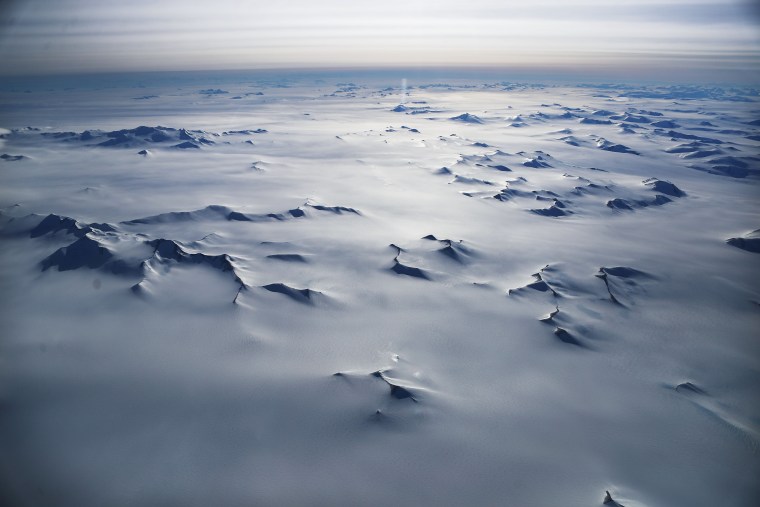
For years, scientists take been exploring means to save the vast sheets of ice roofing Greenland and Antarctica, which equally the climate warms are melting and falling into the ocean.
They've proposed all sorts of possible fixes, from seeding the atmosphere with sunlight-blocking chemicals to cool the planet to pumping seawater onto the ice with the hope that information technology will freeze and replenish lost ice. Just these ideas have been widely criticized for their exorbitant toll — thought to be in the hundreds of billions of dollars a year — and the risks involved.
Now scientists have come upwardly with bold new plans for protecting these massive glaciers — and preventing the potentially devastating rise in sea levels that would occur if they vanished. 1 involves protecting vulnerable glaciers with underwater walls congenital by robots; the other proposes pumping common cold water through vast tunnels bored under the ice to thicken information technology and keep information technology from sliding into the sea.
"These geoengineering projects could filibuster much of the polar glaciers from melting into the sea for centuries," says Michael Wolovick, a glaciologist at Princeton University and one of the scientists behind the new proposals. "Other ideas have been proposed, only the energy costs have been vast. Pumping water on top of polar glaciers also runs the risk of the water draining to the bed of the glacier, lubricating information technology further, and increasing the rate at which it is sliding into the sea."
Implementation of the plans would probable cost tens of billions of dollars. While this is a fraction of the price tag of the other initiatives suggested, broad international cooperation would be needed non but to fund the projects but to manage them.
Why glaciers matter
Underwater walls and subglacial tunnels sound drastic, but their proponents say they may be the best manner to prevent significant ocean level rise as the planet continues to warm. If nosotros do cypher, the oceans are projected to ascension more a meter by 2100. That would pose a grave danger to the 150 meg people beyond the globe living in coastal areas — and could requite the global economy a $fifty-trillion-per-twelvemonth hit.
Scientists are especially worried well-nigh sudden glacial loss. That happened in 2002, when a chunk of ice the size of Rhode Island broke off the east coast of the Antarctic Peninsula and crashed into the Larsen Sea.
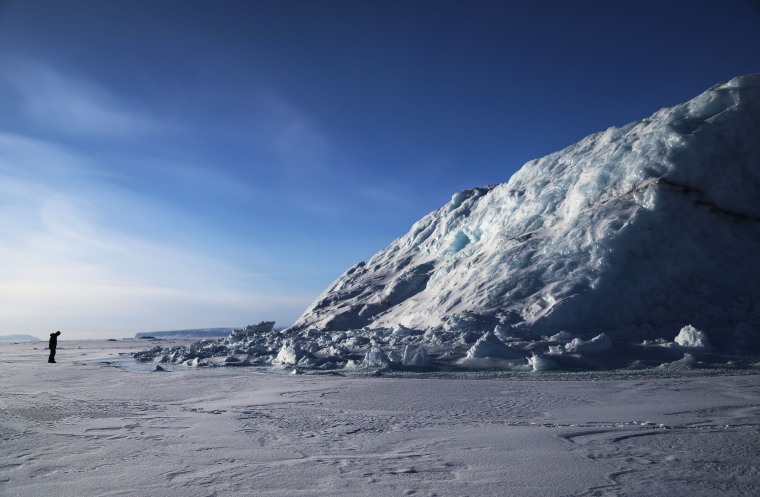
At present there's serious concern about Antarctica's Thwaites and Pino Island glaciers. Satellite photos bear witness that these vast water ice sheets have been shrinking at a charge per unit of about i kilometer a year. If they go away completely, the resulting floods could swamp depression lying regions across the earth, with the Pacific and Atlantic coasts of the U.S likely to carry the brunt of the flooding.
Edifice underwater walls
Having dismissed atmospheric seeding and the pumping of sea h2o onto glaciers, many glaciologists now believe the best way to save glaciers may be to tackle the problem at the source. They suggest constructing enormous walls to preclude warm ocean water from eroding the glaciers' ocean-facing edges, which jut out over and float upon the waves.
"In the polar oceans, you have warm salty water at depth with colder fresher h2o on top," Wolovick says. "This warm h2o is the biggest threat as it causes the base of operations of the floating ice to melt, and the glacier to get unstable. If you lot could cake this water menses, it would reduce the melt rate."
Fabricated mostly of robot-excavated sea sediment, the walls would extend from the ocean floor to the base of operations of glaciers' floating ice — holding it in place while shielding it from warm water.
The size of the wall would depend on the glacier in question. For a small i like the Jakobshavn glacier in western Greenland, Wolovick says, a 100-meter-high wall extending for about five kilometers might suffice. The much larger Thwaites glacier might require a 300-meter-high wall extending for fifty or more kilometers.
Would such walls really finish the ice from melting? Reckoner simulations propose they would. A wall protecting Thwaites glacier, for example, might enable information technology to last some other 400 centuries. That would purchase us time, assuasive people living along vulnerable coastlines to relocate or to build improve sea walls — and possibly we could use the time to find ways to ease global warming.
Cooling hot bedrock
Glaciers lose water ice not simply at the water'southward edge but from underneath. That'due south because glaciers are always moving toward the sea over a thin layer of water just above the underlying boulder. As glaciers move along, their bottom surfaces scrape confronting the bedrock, generating friction and heat and causing some water ice to melt. The problem is that with warming air temperatures causing additional melting, the volume of subglacial water is becoming larger, and glaciers are being accelerated toward the ocean faster than they are being replenished.
Wolovick thinks it might be possible to tinker with the process and ameliorate much of the frictional heating past drilling a series of tunnels in the bedrock and pumping cold alkali through them.
For the Pine Island glacier, he envisions a serial of 5-meter-wide tunnels starting from the nearby Hudson mount range and extending roughly horizontally in the bedrock for 80 kilometers or and so. Once the brine starts flowing, he hopes it could freeze some of the water underneath the glacier, slowing the moving ice in its tracks, and giving the glacier time to strengthen and solidify.
A big debate
Wolovick is convinced that glacier geoengineering is our all-time bet for protecting the planet's water ice, and he's not the but scientist who does.
"This is happening and we can't really close our eyes and forget about the fact that nosotros're driving a dangerous mountain route," says Slawek Tulacyzk, a professor of earth scientific discipline at the University of California, Santa Cruz. "We're either going to be defending the coastline in our ain lawn, or we tin can endeavor and subtract the risk at the source of the problem, where the water ice is being discharged to the sea."
Other scientists disagree, proverb that the money needed for the geoengineering schemes would be better spent on finding ways to lower the amount of the greenhouse gas carbon dioxide that is existence pumped into the atmosphere.
"These approaches are not going to exist effective at winning the state of war considering the root cause of these changes is warming ocean and air temperatures, and addressing those is what's needed for any lasting long-term framework," says Twila Moon, a research scientist at the National Snow and Water ice Data Center in Boulder, Colorado.
The contend over glacier geoengineering isn't probable to get abroad anytime shortly. But researchers from People's republic of china are planning a $3 billion polar research study to evaluate the feasibility of the new proposals over the next decade. So maybe some cold, hard facts will aid settle the argue.
FOLLOW NBC NEWS MACH ON TWITTER, FACEBOOK, AND INSTAGRAM.
Source: https://www.nbcnews.com/mach/science/can-these-bold-plans-keep-world-s-ice-sheets-melting-ncna877616
0 Response to "Can We Freeze the Ice Caps Again to Fight Global Warming"
Post a Comment