Whats 1 Times 1 Divided by What Type of Swan Again Divided by 1
Changed Functions
An inverse function goes the other way!
Let united states of america beginning with an case:
Hither we have the part f(10) = 2x+3, written as a flow diagram:

The Inverse Function goes the other way:

So the inverse of: 2x+iii is: (y-3)/2
The inverse is normally shown by putting a footling "-ane" afterwards the role proper name, like this:
f-ane(y)
We say "f inverse of y"
So, the inverse of f(x) = 2x+3 is written:
f-i(y) = (y-3)/ii
(I as well used y instead of 10 to show that we are using a different value.)
Back to Where Nosotros Started
The absurd thing virtually the inverse is that it should give us back the original value:

When the role f turns the apple tree into a banana,
And then the inverse part f-1 turns the assistant dorsum to the apple
Instance:
Using the formulas from above, we can start with x=iv:
f(iv) = ii×4+3 = xi
We tin can then use the inverse on the 11:
f-1(xi) = (11-iii)/two = 4
And we magically get iv back once again!
Nosotros tin can write that in one line:
f-1( f(4) ) = 4
"f inverse of f of 4 equals four"
So applying a function f and then its inverse f-1 gives u.s.a. the original value dorsum again:
f-1( f(x) ) = x
We could also have put the functions in the other order and it nevertheless works:
f( f-1(x) ) = 10
Example:
Start with:
f-1(11) = (xi-3)/2 = 4
And then:
f(4) = 2×4+three = 11
So nosotros can say:
f( f-1(eleven) ) = 11
"f of f inverse of 11 equals eleven"
Solve Using Algebra
Nosotros can work out the changed using Algebra. Put "y" for "f(ten)" and solve for 10:
| The function: | f(x) | = | 2x+3 | |
| Put "y" for "f(x)": | y | = | 2x+3 | |
| Decrease 3 from both sides: | y-3 | = | 2x | |
| Split both sides by 2: | (y-3)/two | = | ten | |
| Swap sides: | x | = | (y-iii)/ii | |
| Solution (put "f-i(y)" for "10") : | f-1(y) | = | (y-3)/2 |
This method works well for more difficult inverses.
Fahrenheit to Celsius
A useful example is converting between Fahrenheit and Celsius:
To catechumen Fahrenheit to Celsius: f(F) = (F - 32) × v ix
The Inverse Function (Celsius back to Fahrenheit): f-1(C) = (C × ix 5 ) + 32
For you: see if you can do the steps to create that inverse!
Inverses of Common Functions
Information technology has been easy so far, because we know the changed of Multiply is Dissever, and the inverse of Add is Subtract, but what near other functions?
Here is a listing to help you:
| Inverses | Conscientious! | ||
 | <=> |  | |
 | <=> |  | Don't split by null |
| 1 x | <=> | 1 y | x and y not zero |
| x2 | <=> |  | x and y ≥ 0 |
| tenn | <=> |  or or  | north not cypher (different rules when n is odd, even, negative or positive) |
| east10 | <=> | ln(y) | y > 0 |
| ax | <=> | loga(y) | y and a > 0 |
| sin(10) | <=> | sin-1(y) | -π/2 to +π/2 |
| cos(10) | <=> | cos-one(y) | 0 to π |
| tan(10) | <=> | tan-1(y) | -π/2 to +π/2 |
(Annotation: you can read more nigh Inverse Sine, Cosine and Tangent.)
Conscientious!
Did you encounter the "Careful!" column above? That is considering some inverses work merely with certain values.
Instance: Square and Square Root
When we foursquare a negative number, and and so practise the inverse, this happens:
Square: (−2)2 = 4
Inverse (Foursquare Root): √(4) = ii
But we didn't get the original value back! We got 2 instead of −2. Our fault for not existence conscientious!
So the square function (as information technology stands) does not take an changed
Just we tin fix that!
Restrict the Domain (the values that tin go into a function).
Case: (connected)
Just make certain nosotros don't use negative numbers.
In other words, restrict it to x ≥ 0 then we can have an inverse.
Then we have this situation:
- x2 does not have an inverse
- but {xii | x ≥ 0 } (which says "x squared such that 10 is greater than or equal to cypher" using set-builder notation) does have an inverse.
No Inverse?
Permit us see graphically what is going on here:
To be able to take an inverse nosotros need unique values.
Just think ... if there are two or more x-values for one y-value, how do we know which one to choose when going back?
Imagine we came from tenane to a particular y value, where exercise nosotros become back to? 10i or x2?
In that case we can't have an inverse.
But if nosotros can accept exactly one 10 for every y we tin can have an inverse.
It is called a "one-to-one correspondence" or Bijective, similar this
A function has to exist "Bijective" to take an changed.
So a bijective function follows stricter rules than a general part, which allows us to have an changed.
Domain and Range
Then what is all this talk nigh "Restricting the Domain"?
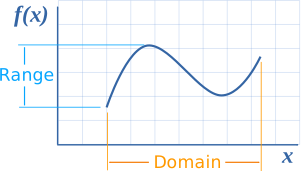
In its simplest grade the domain is all the values that go into a function (and the range is all the values that come out).
Equally information technology stands the function to a higher place does non have an inverse, because some y-values will have more than one x-value.
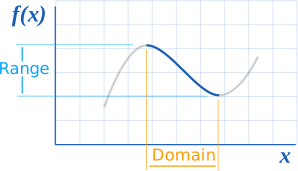
Just we could restrict the domain then there is a unique x for every y ...
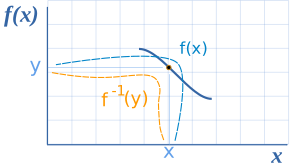
... and now we can accept an inverse:
Note likewise:
- The function f(x) goes from the domain to the range,
- The changed role f-1(y) goes from the range back to the domain.
Let'due south plot them both in terms of 10 ... so it is now f-i(10), non f-i(y):
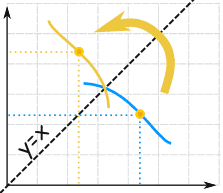
f(x) and f-i(x) are like mirror images
(flipped most the diagonal).
In other words:
The graph of f(x) and f-i(x) are symmetric across the line y=x
Case: Square and Square Root (continued)
First, we restrict the Domain to x ≥ 0:
- {102 | 10 ≥ 0 } "x squared such that x is greater than or equal to cypher"
- {√10 | 10 ≥ 0 } "foursquare root of x such that x is greater than or equal to zero"
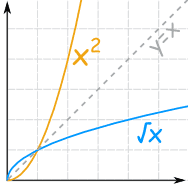
And you can see they are "mirror images"
of each other about the diagonal y=10.
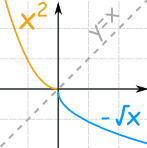
Annotation: when we restrict the domain to ten ≤ 0 (less than or equal to 0) the inverse is then f-1(x) = −√10:
- {x2 | 10 ≤ 0 }
- {−√x | x ≥ 0 }
Which are inverses, too.
Not Always Solvable!
It is sometimes not possible to detect an Changed of a Role.
Case: f(x) = x/2 + sin(x)
Nosotros cannot work out the inverse of this, because we cannot solve for "x":
y = x/two + sin(x)
y ... ? = x
Notes on Notation
Even though nosotros write f-1(10), the "-1" is not an exponent (or power):
| f-1(10) | ...is different to... | f(x) -1 |
| Changed of the office f | f(x)-ane = ane/f(x) (the Reciprocal) |
Summary
- The changed of f(ten) is f-1(y)
- Nosotros can find an inverse by reversing the "flow diagram"
- Or nosotros can find an inverse by using Algebra:
- Put "y" for "f(x)", and
- Solve for x
- We may need to restrict the domain for the function to accept an inverse
Source: https://www.mathsisfun.com/sets/function-inverse.html
0 Response to "Whats 1 Times 1 Divided by What Type of Swan Again Divided by 1"
Post a Comment